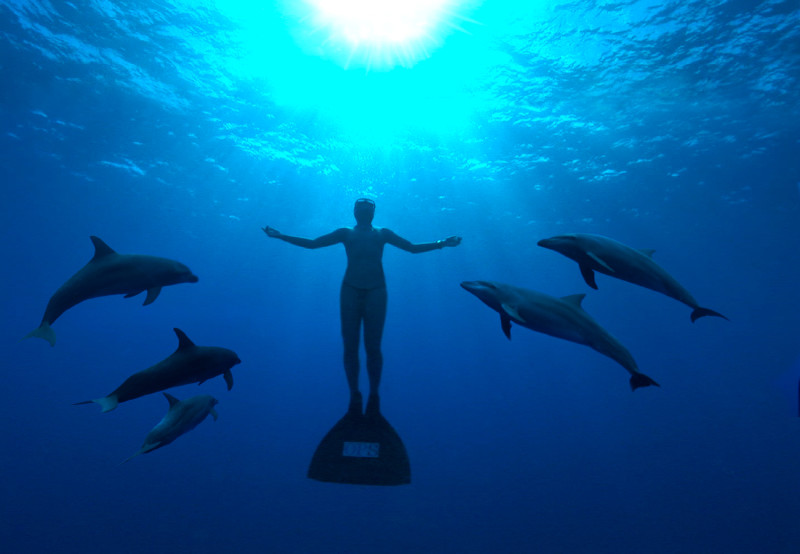
As the recent documentary, Dolphin Boy makes the rounds, hitting film festivals and networks, we all have to ask.....what's the deal with dolphin assisted therapy (DAT)?
Science or Scam?
Dr. Lori Marino, senior lecturer in the Neuroscience and Behavioral Biology Program at Emory University, has been campaigning against this unique form of dolphin captivity for years, warning of it's predatory nature. Often, parents who are willing to try anything to help a disabled child resort to this murky form of "healing.""Dolphin-assisted therapy is not a valid treatment for any disorder," says Marino, a leading dolphin and whale researcher. "We want to get the word out that it's a lose-lose situation for people and for dolphins."
Marino and Emory colleague, Scott Lilienfeld, professor in the Department of Psychology, launched an educational campaign countering claims made by purveyors of DAT.
In their study, "Dolphin-Assisted Therapy: More Flawed Data and More Flawed Conclusions" originally published in 1998 and updated in 2007, they debunked claims that DAT was a valid form of science. Focusing in five specific papers over the years, they systematically broke down the claims.
"We found that all five studies were methodologically flawed and plagued by several threats to both internal and construct validity," wrote Marino and Lilienfeld.
"We conclude that nearly a decade following our initial review, there remains no compelling evidence that DAT is a legitimate therapy, or that it affords any more than fleeting improvements in mood."
Programs are not cheap. Packages at the Crimean facility of a Dr. Lukina can run up to 4000 Euros per patient.
One is told:
"A filing (sic) of a joy and harmony during the treatment sessions in the hearts of children, their parents and support team is a guaranteed outcome. Contacts with the friendliest creatures of the sea and therapy sessions are like a game for patients and others. It is, nevertheless, a very important part of a therapy sessions."
Yet Marino's study found multiple flaws with Lukina's methodology. Lukina's results of DAT tests did not sufficiently describe testing methods, details were sorely lacking.
Also, according to Marino: "The pivotal weakness of the Lukina study is the absence of a control group consisting of children who did not swim with dolphins. Therefore, the study does not meet the minimal criteria for basic experimental design. This flaw alone renders the Lukina study difficult to interpret even without the myriad other threats to validity."
Dr. Lukina claims to offer relief from a range of afflictions including chronic fatigue syndrome, phobias, depression and cerebral palsy, all at her facility at the State Oceanarium of Ukraine.
According to Marino, "Dr. Lukina depends heavily – if not solely – on touting 'experience' and on testimonials (which is always a red flag for pseudoscience claims). So, there is no evidence at all that what they are doing there is therapy in any meaningful sense of the word."
DAT's not good.
~Viki Psihoyos~
Photo: Dr. Lukina's site


Comments
and it's magical. If it's ok for an autistic child to use a horse as a type of "therapy", why not a dolphin. I'm completely against the way dolphins are captured in Japan, but I'm just saying this particular subject should be analyzed properly.
dolphins, why not experience dolphins in the wild on their terms where the dolphins have the choice to interact or not. I swam with wild dolphins in a marine preserve in the Red Sea. Those dolphins had the choice to come play with me or not and were not pressured
to "perform" by their handlers. What is there to lose when you allow dolphins that freedom of choice?
real wild dolphins,just seeing them will help them,and kep the dolphins wild. or go and see dolphins that are being cared for cos they were injured or caught in nets etc.there are a few places in the world like this now.we dont need seaworld with captive dolphin
or orca...seaworld is ok for education but they still should not have these creatures unless they really are rehabilitating them.
animal selected to play an integral part of a person’s treatment process that demonstrates a good temperament and reliable, predictable behavior. A therapy/emotional support animal is prescribed to an individual with a disability by a healthcare or mental
health professional. A therapy/emotional support animal is not a service animal. Unlike a service animal, a therapy/emotional support animal does not assist a person with a disability with activities of daily living, nor does it accompany a person with a disability
at all the times. However, a therapy/ emotional support animal may be incorporated into a treatment process to assist in alleviating the symptoms of that individual’s disability. This treatment occurs within the person’s residence and therefore may be considered
for access to university housing. Dolphins are wild. Just because they have the ability to be domesticated, doesn't mean that they should be. There are thousands of creatures out there that can be domesticated. Just because we live in an age that's all about
conquering new discoveries, doesn't mean that man has the green light to force changes to wild species to accommodate selfish endeavors. http://www.byu.edu/familyhousing/guidelines/animal_policy.pdf Audrey
in The Cove you should care about dolphins confined for dolphin therapy. They are often one in the same. Second, I agree that the subject requires proper analysis. We have done that and published our results in peer-reviewed scientific journals. The results
show unequivocally that despite what it might "look" like there is no real therapy going on with dolphin swims. I appreciate your concern for the dolphins and for autistic children. That is why I am concerned about dolphin therapy - it exploits both. Thanks.
Put a price on speaking for the first time, the stopping the need for diapers, the improved social behavior while in public… If there is a journalist that cares about the quality of life of our least fortunate – I dare them to come to the Cayman Islands and
research the program first hand. I double dare them.
of the water. When I tried to swim up, he pushed me back down to the bottom of the water. The instructors were so busy with irritated people wanting their 5 minutes. I almost drowned, but I was eventually rescued. The second experience was: In the wild off
the coast of Florida- most beautiful experience I ever had. A group of dolphins came to our boat and "hung out" with us for at least 2 hours. We played fetch with a hat. This "healed" my previous experience as a child. To me, I believe that Dolphins are happier
out in the wild. These animals are self-aware and intelligent beyond our understanding. I'm not knocking incorporating animals into therapy, but do they have to be captive to create a mutually beneficial relationship? I am not a licensed psychologist, therapist,
or counselor. But being a survivor of abuse & neglect, I found a domesticated animal beneficial to my recovery and communication. Although, My perspective is biased by my personal experiences. I think any relationship with an animal requires trust, and supplying
to the needs of that animal. It is the same for humans, why not dolphins?
not. And that brings up a good point - many people who are against 'dolphins in captivity' hypocritically own dogs (another intelligent animal that is domesticated) or eat pork (an intelligent animal that is slaughtered for their lunch). You can't have both
- if you think 'dolphins in captivity' is wrong, you must think ANY animal in captivity is wrong. The dolphins at reputable facilities are domesticated animals. They live longer than dolphins in the wild. They receive the equivalent to a human physical EVERYDAY
to look for health problems (which are rare at reputable facilities). And most importantly, these happy dolphins are helping change human lives for the better - it's a WIN-WIN for both humans and dolphins... at the reputable facilities. Finally, Lori Marino
has a huge stake in being anti-dolphin. She has lumped ALL dolphin therapies into one category, trying to claim that ALL parks capture their dolphins in inhumane ways. That's simply not true. She's playing on the emotions of those who viewed The Cove and felt
like they needed to go do something. The fact is some parks are not good with their animals... and they give the rest of the facilities (yes, that's why I said 'reputable facilities' over and over) a bad name. There are some places that have a great track
record with their animals, who treat their animals better than humans are treated, and who are literally saving the lives of special needs families and children. Don't let a part-time activist and bandwagon jumper (Lori Marino) who probably benefits monetarily
with her anti-dolphin views override your intelligence. Check it out yourself. Do the research on the good parks and bad parks.
so quickly.
to help fix this issue?
täglich aktualisiert, wo jeder Berater die Chance bekommt, auf der Startseite seinen Service hervorgehoben anzubieten.
happier out in the wild. These animals are self-aware and intelligent beyond our understanding. I'm not knocking incorporating animals into therapy, but do they have to be captive to create a mutually beneficial relationship? I am not a licensed psychologist,
therapist,
public speaking training
cleanmypc
8 ballz
Romantic Poems
essay writing uk
Love Bracelet Replica
short funny jokes